Showing posts with label UNHCR. Show all posts

Wednesday, February 11, 2015

More Than 200 Migrants Feared Dead After Boats Sink in Mediterranean

By VICE News
February 11, 2015 | 1:16 pm
More than 200 migrants are missing in the Mediterranean sea after the motorboats they were traveling in sank, the UN refugee agency says.
Nine people were saved after four days at sea, but a further 203 were "swallowed up," Carlotta Sami, the UNHCR spokeswoman in Italy, said on Twitter.
She called the incident a "horrible and enormous tragedy."
The two boats departed from the Libyan coast on Saturday, according to the International Organization for Migration.
Lauren Jolles, UNHCR officer for Southern Europe, criticised Operation Triton — Europe's Mediterranean border patrol — for lacking a "core mandate" of saving human lives.
"We are shocked by the news of the death of another 203 migrants and refugees," she said in a statement.
She added: "The Operation Triton does not have as its core mandate of saving human lives and therefore can not be the answer of which is urgently needed."
Triton was brought into replace Operation Mare Nostrum, the Italian government's program of maritime patrols, which ended last year to warnings from refugee experts that the death toll could soar. The EU operation, run by the bloc's border agency Frontex, covers a much reduced search area and is mandated with border surveillance rather than search and rescue.
Nils Muiznieks, human rights commissioner of the Council of Europe, also denounced Triton's inadequacy, saying the loss of life could have been avoided.
The news comes just days after 29 migrants died after their inflatable raft capsized near the Italian island of Lampedusa. 22 of those died from hypothermia after being picked up by a rescue vessel.
More than 165,000 undocumented migrants tried to cross the Mediterranean to Europe in the first nine months of 2014, accroding to the UN refugee agency UNHCR, compared with 60,000 for the whole of 2013. Almost half of the 2014 migrants were Syrians and Eritreans.
At least 3,000 died or went missing at sea in 2014, according to UNCHR estimates, compared to over 600 in 2013.
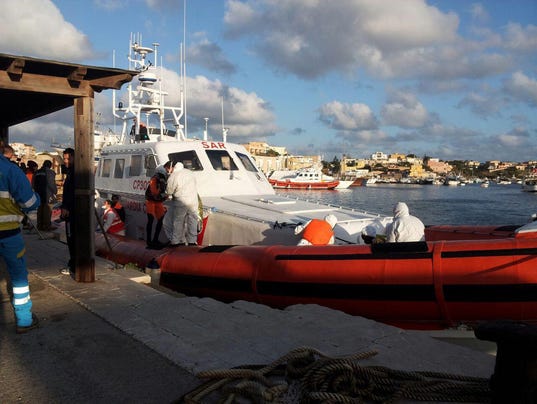
Main image: Migrants are picked up by an Italian navy patrol in December. Image via the Italian navy.

Thursday, December 11, 2014

Nearly 3,500 Migrants reportedly died in 2014 alone while crossing the Mediterranean: UNHCR

GENEVA (UNHCR) – The UN refugee agency on Wednesday warned that the international community was losing its focus on saving lives amid confusion among coastal nations and regional blocs over how to respond to the growing number of people making risky sea journeys in search of asylum or migration.
Group  risking their lives to reach Europe from North Africa
With preparations under way for the opening today in Geneva of UNHCR's 2014 High Commissioner's Dialogue – an informal policy discussion forum whose focus this year is "Protection at Sea" – UN High Commissioner for Refugees António Guterres said some governments were increasingly seeing keeping foreigners out as being a higher priority than upholding asylum.
"This is a mistake, and precisely the wrong reaction for an era in which record numbers of people are fleeing wars," Guterres said. "Security and immigration management are concerns for any country, but policies must be designed in a way that human lives do not end up becoming collateral damage."
The clandestine nature of these sea crossings makes reliable comparisons with previous years difficult, but available data points to 2014 being a record high. According to estimates from coastal authorities and information from confirmed interdictions and other monitoring, at least 348,000 people have risked such journeys worldwide since the start of January. Historically, a principal driver has been migration, but this year the number of asylum-seekers involved has grown.
Europe, facing conflicts to its south (Libya), east (Ukraine) and south-east (Syria/Iraq) is seeing the largest number of sea arrivals. Although not all are people needing asylum, more than 207,000 people have crossed the Mediterranean since the start of January – almost three times the previous known high of about 70,000 in 2011, when the Libyan civil war was in full swing. For the first time, people from refugee-producing countries (mainly Syria and Eritrea) have in 2014 become a major component in this tragic flow, accounting for almost 50 per cent of the total.
In addition to the Mediterranean, there are at least three other major sea routes in use today both by migrants and people fleeing conflict or persecution. In the Horn of Africa region 82,680 people crossed the Gulf of Aden and Red Sea in the first 11 months of this year en route mainly from Ethiopia and Somalia to Yemen or onwards to Saudi Arabia and the countries of the Persian Gulf.
In Southeast Asia, an estimated 54,000 people have undertaken sea crossings so far in 2014, most of them departing from Bangladesh or Myanmar and heading to Thailand, Malaysia or Indonesia. In the Caribbean, at least 4,775 people are known to have taken to boats in the first 11 months, hoping to flee poverty or in search of asylum.
And many die or fall victim to international organized crime in the process of making these journeys. Worldwide, UNHCR has received information of 4,272 reported deaths this year. This includes 3,419 on the Mediterranean – making it the deadliest route of all. In Southeast Asia, an estimated 540 people have died in their attempts to cross the Bay of Bengal.
In the Red Sea and Gulf of Aden, at least 242 lives had been lost by December 8, while in the Caribbean the reported number of dead or missing as of the start of December was 71. People smuggling networks are meanwhile flourishing, operating with impunity in areas of instability or conflict, and profiting from human desperation.
Guterres said that by focusing on isolated elements to a problem that by its nature is multi-layered and transnational – often involving routes that stretch across multiple borders and over thousands of kilometres – governments were finding themselves unable to either stem the flow or stop people dying along the journey.
"You can't stop a person who is fleeing for their life by deterrence, without escalating the dangers even more," said Guterres. "The real root causes have to be addressed, and this means looking at why people are fleeing, what prevents them from seeking asylum by safer means, and what can be done to crack down on the criminal networks that prosper from this, while at the same time protecting their victims. It also means having proper systems to deal with arrivals and distinguish real refugees from those who are not."
This year's High Commissioner's Dialogue gathers representatives of governments, non-governmental organisations, coast guard and, academics as well as representatives from partner international organisations. It is being held in Geneva's Palais des Nations over today and Thursday.

Source: UNHCR

Saturday, November 22, 2014

We have no asylum-seekers in Ethiopia: Eritrea's U.N. Ambassador

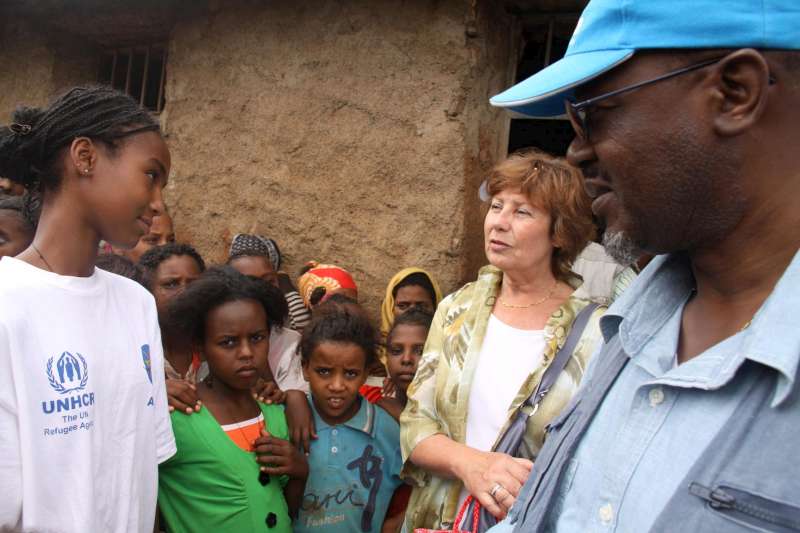
Unaccompanied Eritrean refugee children in Ethiopia
Eritrea’s top diplomat to the United Nations says the U.N. High Commissioner for Refugees has committed a “conceptual mistake” in a report, which stated that in the past 37 days more than 6,000 Eritreans had claimed asylum in neighboring Ethiopia.

The U.N. refugee agency said Eritrea’s renewed conscription drive was to blame for the sharp increase in the number of youths fleeing the country.

But Eritrea's U.N. ambassador, Girma Asmerom, dismissed the report as a calculated effort to undermine the government by creating disaffection among its population. He said Eritrean citizens migrate just like other nationals, which he said is a global phenomenon.
“The U.N. has to do its bit of homework, because there are no asylum-seekers in Ethiopia,” said Asmerom. “We do not understand why they are

Wednesday, September 24, 2014

Number of Syrian Kurds fleeing to Turkey nears 140,000: UNHCR

GENEVA. September 23 (UNHCR) The UN refugee agency on Tuesday said more than 138,000 refugees, mainly ethnic Kurds fleeing militant threats to towns and villages in northern Syria, have crossed into southern Turkey since Friday.
The latest arrivals passed through the two remaining open border points at Yumurtalik and the crossing east of Murstipinar/Akmanak.
UNHCR spokesperson Melissa Fleming said the Turkish authorities had told the refugee agency that they are now managing the entry of refugees through two border points (previously nine) in three phases: security checks in order to maintain the civilian character of asylum; health checks, including measles and polio vaccination for very young children; and registration.
Mobile registration centres, large trucks donated by UNHCR and complete with computers, biometric and photographic equipment, are operating in the border crossing of Yumurtalik and in the yard of a primary school of Namik Kemal, Suruc.
Registration is also being carried out by government officials at a boarding school in Onbirnisan, in Suruc district hosting an estimated 50,000 refugees, as well as the Suruc town center less than 15 kilometers from the Syrian border.
Once registered, refugees receive an ID card, which provides access to free health care services in Turkish clinics, as well as other aid provided by local municipalities, non-governmental organizations and other aid agencies. The card is a critical document that also shows refugees have the temporary protection of the Turkish government.
"UNHCR field staff are visiting the border areas and areas hosting refugees on a daily basis, assessing urgent needs and coordinating the response among other humanitarian actors," Fleming said.
"Our field staff report the majority of new arrivals are women, children and the elderly, who arrive exhausted having walked several kilometers to safety on a dusty, rough road, with their luggage. Some of the elderly and disabled are carried to safety by relatives, their wheel chairs hopelessly unsuited to the rough terrain," she added.
On arrival, the refugees are given water before being transported to a registration point. The Turkish Red Crescent has set up a medical observation tent for injured refugees and more than 290 Syrians were taken to the Suruc hospital by ambulances over the weekend.
The refugee agency has already provided tens of thousands of relief items blankets, sleeping mats, jerry cans and plastic sheets to help in the response, coordinated by the government of Turkey. More aid is on the way.
UNHCR's Fleming said the first in a series of airlifts bringing aid for up to 200,000 people is expected to arrive in Turkey, from Amman, Jordan, on Wednesday afternoon. Another three flights from Amman and Copenhagen are expected to follow later in the week.
Many refugees are sheltering with relatives and friends, while others are staying in schools, wedding halls, mosques or other buildings. The Turkish government has set up two transit centres for 10,000 people each at Suleymansah Park in Mursitpinar and Onbirnisan, in Suruc, with support from UNHCR. The government also continues its work on two new camps already under way Derik Camp in Mardin and Islahiye camp also with UNHCR support.
Source: UNHCR